Biochar and the scaling challenge
from artisanal pits to industrial climate infrastructure
3/10/20268 min read
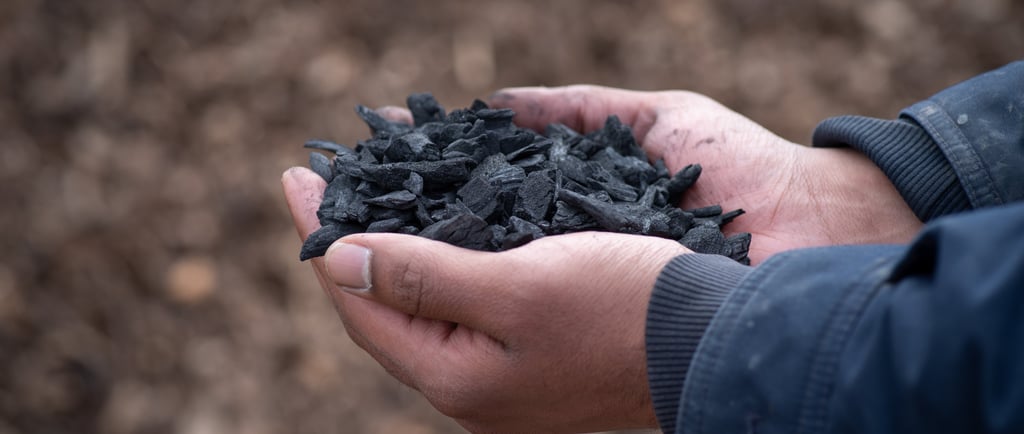
A black, porous material made from burnt biomass might not look like much. But biochar is quietly becoming the backbone of today's engineered carbon removal market — and the pressure to scale it is intensifying by the month. The question is no longer whether biochar works. It does. The question that investors, developers, and policymakers are now wrestling with is far more urgent: how do we industrialise it fast enough to matter?
Worldwide, an increasing number of biochar projects are emerging, but most remain small. Many artisanal operations still produce biochar in half-open pits or rudimentary kilns. Meanwhile, the climate clock ticks. Biochar Carbon Removal (BCR) is arguably the most scalable and cost-effective method of removing carbon dioxide from the atmosphere that we currently have — and yet its potential remains overwhelmingly untapped. Understanding why, and what it will take to change that, is the central challenge facing the sector today.
Why biochar matters more than ever
Biochar is created when biomass — agricultural waste, forestry residues, wood chips, rice hulls — is heated in a low-oxygen environment through a process called pyrolysis. The result is a stable, carbon-rich material that, when applied to soils or embedded in construction materials, locks away carbon for decades to centuries.
What makes biochar exceptional in the carbon removal landscape is its combination of attributes: it is proven, relatively affordable, and already delivering the vast majority of engineered carbon removal credits sold globally today. Biochar Carbon Removal accounted for 89.4% of all durable CDR delivered in Q2 2025 — a dominant position that reflects both the technology's maturity and the slow ramp-up of alternatives like direct air capture.
Demand is accelerating sharply. From 2022 to mid-2025, approximately 3.04 million tonnes of BCR credits were contracted — with roughly 1.6 million tonnes of that purchased in the first half of 2025 alone. The market's growth rate from 2023 to 2024 was a remarkable 435%. Major corporate buyers — Microsoft, Google, Swiss Re, BCG, JPMorgan — are not just dipping their toes in; they are signing multi-year, multi-hundred-thousand-tonne agreements. In May 2025, Microsoft signed a landmark ten-year, 1.24-million-tonne offtake agreement with Bolivian producer Exomad Green — the largest biochar deal in history. Swiss Re followed with a separate seven-year, 70,000-tonne agreement through Carbonfuture.
By the end of 2025, Carbonfuture had facilitated the world's first megatonne BCR agreement, a milestone that signals the market's transition from niche experimentation to genuine scale.
And yet, supply remains acutely constrained. As of late 2025, 62% of high-quality biochar capacity for the year had already been locked into contracts by repeat buyers, with an additional 28% secured through 2026. The market is sold out. For developers, this is an extraordinary commercial opportunity — but unlocking it requires overcoming a set of structural barriers that have kept the sector fragmented.
The market in numbers
To appreciate the challenge, it helps to understand the market's current dimensions:
Global biochar market size is estimated at 0.88 million tonnes in 2026, growing from 0.71 million tonnes in 2025, and forecast to reach 2.59 million tonnes by 2031 at a CAGR of ~24%.
Credit prices for industrial biochar currently cluster between €125 and €200 per tonne CO₂e, depending on origin, certification, and buyer proximity. Industrial biochar from Bolivia trades at roughly €160–€180/tonne; German-origin biochar commands a domestic premium of €189–€200. Indian biochar, the lowest-cost option, starts around €105/tonne at industrial scale.
The CORCCHAR index, hosted on Nasdaq, published prices of roughly €125–€145/tonne for near-term delivery contracts throughout 2025 — reflecting arm's-length, market-negotiated transactions under the Puro Standard.
Market liquidity has improved dramatically: the time from credit issuance to retirement fell from 95 days in 2021 to just 22 days by mid-2025.
Broader biochar industry revenues (production plus credits) exceeded €600 million annually as of 2023, with projections approaching €3.3 billion by 2025 and continuing toward €3 billion+ by 2030.
The opportunity is unambiguous. What is needed is the infrastructure — financial, technological, and regulatory — to meet it.
The 5 scaling barriers (as of 2026)
1. Financing and contract bankability
The most persistent obstacle to scaling is not the technology; it is the deal structure. Infrastructure investors — the kind whose capital can fund the 1,000+ new BCR facilities needed annually by 2030 — require predictable, long-term cash flows. They want contracts with fixed delivery volumes, clear payment schedules, force majeure provisions, and enforceable remedies for non-delivery. Ambiguity kills deals.
The good news is that the market is maturing. Buyers are shifting away from spot purchases toward long-term offtake agreements — pre-committing to years of future production to secure supply in a tightening market. This shift is exactly what developers need to build bankable project finance cases. However, the transition is uneven: many smaller developers still lack the commercial sophistication to structure agreements that satisfy institutional investors. The gap between a willing buyer and a financeable project remains real.
Developers must approach contract design from both an engineering and an investor lens simultaneously. This means not only delivering reliable biochar quality, but demonstrating through the contract itself that risk is understood, allocated, and manageable.
2. The voluntary carbon market's structural fragility
Biochar credits still sit outside compliance carbon markets. This means developers depend entirely on voluntary corporate buyers — a market that, despite its impressive growth, remains concentrated among a small number of sophisticated purchasers. The number of active buyers is low even as volumes climb. Sentiment in late 2025 showed cracks: tech-based CDR retirements fell sharply from 57,417 metric tonnes in September 2025 to just 3,327 metric tonnes in October — signalling that corporate procurement can be lumpy and unpredictable.
This fragility has two implications for developers. First, robust Monitoring, Reporting and Verification (MRV) systems are no longer optional; they are table stakes for attracting and retaining buyers. Second, the sector needs broader demand — more buyers, more mandates, and eventually compliance linkage — to reduce concentration risk.
Progress is being made on the standards front. In 2025, the ICVCM approved Verra's VM0044 (v1.2), Isometric's Biochar Production & Storage methodology, and CAR's US/Canada Biochar methodology. Puro.earth updated its approach to permanence, introducing new durability classifications (CORC200+, guaranteeing carbon removal for several centuries; CORC100+, guaranteeing over a century). Cross-standard workshops are bringing major registries — Puro.earth, Verra, Isometric, Carbon Standards International — together to align permanence quantification and reduce buyer confusion.
The EU Carbon Removal Certification Framework (CRCF), now operational, is a pivotal development for European developers, creating a regulatory "operating system" for the sector that signals durable demand and reduces policy risk for investors.
3. Multi-Revenue models and the additionality puzzle
No viable biochar project lives on carbon credits alone. Successful projects typically combine at least two of three revenue streams: carbon removal credits, physical biochar sales (to agriculture, construction, or water treatment sectors), and energy byproducts (heat and syngas from the pyrolysis process). This diversification is not just a commercial strategy — it is what makes projects resilient when one revenue stream underperforms.
Physical biochar demand is expanding rapidly into new applications. Biochar is increasingly used in construction materials — concrete, asphalt, polymer composites — where it acts as a durable filler while locking away carbon in infrastructure for decades. Biochar-based water filtration media are also gaining commercial traction, with at least one company now holding patents for converting rice hulls into biocarbon filtration products.
But managing multi-revenue models is genuinely complex. Proving "additionality" — demonstrating that the carbon removal would not have happened without the credit revenue — becomes harder when physical product sales are strong, and vice versa. Developers must navigate these requirements carefully, and investors must be educated on why this complexity is a feature of resilient project design, not a red flag.
4. Technology Selection in an Exploding Landscape
The pyrolysis technology landscape has diversified enormously. Continuous kilns, batch reactors, flash carbonisation systems, and hybrid platforms each carry different cost profiles, feedstock tolerances, scalability characteristics, and operational risks. Choosing wrong is expensive: a plant optimised for wood chips may perform poorly on agricultural residues, and a system with high capital costs may not pencil out without long-term revenue certainty.
Co-location with existing industrial operations — biomass processors, sawmills, food production facilities — is becoming a popular strategy, reducing feedstock logistics costs and leveraging shared infrastructure. But integration with existing operations requires careful technical and commercial structuring.
Emerging tools are also improving operational reliability. Machine learning models are now being applied to predict and optimise pyrolysis emissions (including NOx), enabling better compliance management at scale. As the sector matures, best practices around technology selection are becoming clearer — but developers entering the market still face a steep learning curve.
The leader to watch is Bolivia's Exomad Green, which has built an industrial-scale BCR platform converting hardwood forestry residues at two Puro.earth-certified pyrolysis plants. As of early 2026, the company is sequestering approximately 260,000 tonnes of CO₂ annually and targeting 1 million tonnes per year across five facilities by 2027. It is the most instructive proof point the sector has that genuine industrial scale is achievable.
5. Documentation, permitting, and compliance overhead
The administrative burden of operating a certifiable BCR project is substantial and consistently underestimated by first-time developers. Life Cycle Assessments (LCAs), MRV system implementation, environmental permitting, registry reporting, safety compliance across multiple jurisdictions, proof of permanence, and feedstock chain-of-custody documentation — all of these must be in place before the first credit can be sold.
Early engagement with regulators is essential. Developers who treat permitting as a late-stage checkbox routinely find themselves delayed by twelve to eighteen months. The most successful projects treat compliance planning as a parallel workstream from day one, staffed by specialists who understand both the technical requirements and the registry-specific nuances.
Standardisation is improving. As methodologies mature and registries converge on shared approaches to permanence and MRV, the compliance overhead per project should decrease. But in 2026, this remains a genuine barrier — particularly for developers operating across multiple geographies with different regulatory environments.
Insurance: the emerging enabler
One of the most important structural developments of the past two years is the emergence of biochar-specific insurance products. Non-delivery risk and credit-quality risk are significant concerns for buyers and financiers alike. If a project fails to deliver contracted volumes — due to equipment failure, feedstock disruption, regulatory setbacks, or natural disaster — buyers face reputational and financial exposure, and developers face liability.
Insurers like Kita have begun offering products tailored to BCR projects, transferring these risks to balance sheets better equipped to hold them. The availability of insurance does several things at once: it reduces the risk premium that financiers demand, it strengthens the credibility of offtake contracts in the eyes of buyers, and it signals that the sector is mature enough to be assessed and priced by the insurance industry.
This is a structural shift that deserves more attention than it typically receives. As insurance products become cheaper and more standardised, they will be a key unlock for the mainstream institutional capital that the sector needs.
What developers must do
The path from small-scale pilot to investable, industrial-scale BCR project is demanding but navigable. The developers succeeding today share several characteristics:
Design for bankability from day one. Every contract clause, every technology choice, every MRV system should be stress-tested against the question: would a conservative infrastructure investor be comfortable with this? If the answer is no, fix it before attracting capital.
Build diversified, clearly articulated revenue models. Multiple revenue streams protect against market volatility and improve project resilience. But they need to be explained clearly to investors — complexity is only valuable if it is legible.
Invest in technology diligence upfront. The cost of selecting the wrong pyrolysis system dwarfs the cost of proper technical due diligence. Engage engineers and operators who have built and run plants at the scale you are targeting.
Engage regulators as partners, not gatekeepers. Early, transparent engagement with permitting authorities and registry bodies pays dividends. The projects that move fastest are those whose developers understand the regulatory landscape as well as the technical one.
Use data as a competitive advantage. High-quality, continuous operational data — on feedstock inputs, process parameters, biochar quality, and carbon stocks — is increasingly what differentiates premium-priced projects from commodity producers. Invest in digital infrastructure accordingly.
The big picture: a sector at an inflection point
The numbers required to make a meaningful dent in atmospheric carbon are sobering. To meet ambitious climate targets, the sector needs to build over 1,000 new BCR facilities per year by 2030. Against the current base of a few hundred significant operations worldwide, that represents multiple orders of magnitude of growth.
But the conditions for that growth are assembling. Demand is structurally strong and growing. Standards are converging. Insurance is becoming available. The first megatonne-scale projects are operating. And the price of biochar credits — holding at roughly €125–€200/tonne even as volumes grow — signals that the market can support serious investment returns.
The missing link, as it has always been, is not technology or demand. It is the gap between the ambition of biochar's potential and the professionalism, predictability, and risk management that mainstream infrastructure capital requires before it writes large cheques.
The sector is closer to closing that gap than it has ever been. The developers who get there first will not just capture extraordinary commercial returns — they will have helped build one of the most important climate technologies of the next decade.
Contact
Better Carbon B.V.
Schengestraat 35
4461 EW Goes
Netherlands
KVK / CoC: 98111493
Address
© 2026 Better Carbon BV
Robin: +31 6315 38878
Abhinand: +31 6877 23769
Wouter: +31 6147 59928