Biochar substrates for horticulture
Project with HAS Green Academy
5/14/20262 min read
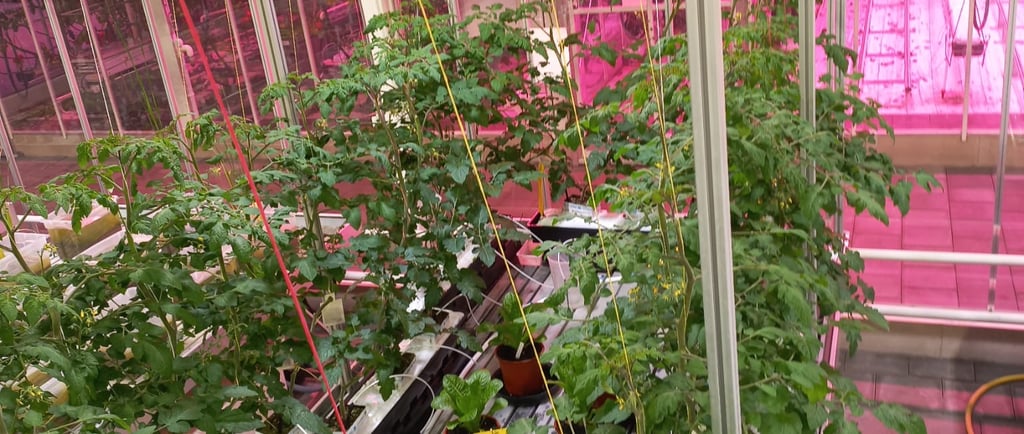
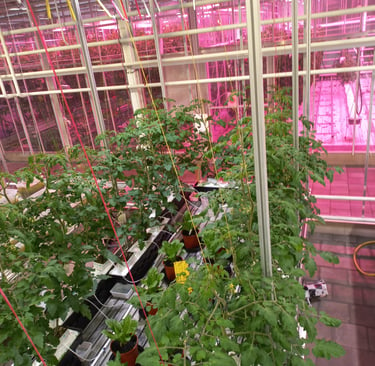
The Netherlands has no shortage of greenhouses — and the growing media inside them is overdue for a rethink.
Together with HAS green academy, we're running trials comparing rock wool with biochar as a substrate for tomatoes - a project close to our hearts. Here's why it matters:
Conventional substrates — peat, perlite, rock wool, coco coir — come with a heavy carbon footprint and are often energy-intensive to produce. Peat is already being phased out. The industry needs quality, climate-positive alternatives.
Enter biochar.
Early results are promising: biochar-grown tomatoes are performing on par with rock wool. And we're just getting started — blended substrates are showing real potential for what comes next.
Perhaps best of all? The biochar substrates can be reused several times as substrate but also as ingredient for a new substrate blend (as opposed to rock wool) and once the growing cycles are done, biochar substrates can be returned to the soil, where they continue to sequester carbon and improve soil health long-term.
Now, let's dive into what the data is telling us so far. The headline: biochar-grown tomatoes are performing on par with rock wool. That's not a minor claim. Rock wool has been the gold standard in Dutch greenhouse horticulture for decades — optimised, trusted, and deeply embedded in grower workflows. For a climate-positive alternative to match it at this stage of trialling is a meaningful result.
What we're measuring: we're running a full harvest analysis across multiple trusses — tracking fresh weight, dry weight, acidity, pH, and Brix for every harvest. Nutrient analysis of fruit and leaf samples is underway at NovaCropControl, with results expected shortly. One of the more telling signals so far: drain percentages. The coarse biochar substrate surpassed rock wool on drainage about three weeks into the trial. The fine biochar substrate has now followed suit — beginning to outperform rock wool on drain percentages as well, though we're watching this closely as it fluctuated week to week.
Going deeper: pF curves. As the trial has evolved, we've identified a relevant addition to the research scope: establishing pF curves for our biochar. A pF curve maps the relationship between a substrate's moisture content and the matric potential — basically, how tightly water is held, and how easily plants can extract it. This matters for understanding whether a substrate can reliably deliver water to roots under varying conditions. To our understanding, pF curves for our biochar substrate composition doesn't yet exist in the literature. That makes this a real novel contribution — and one we're committed to completing for both our coarse and fine biochar variants.
The bigger picture: multiple trusses have been harvested. Leaf and fruit samples heading to the lab. Water retention experiments showing early interesting results. And the plants? They handled a heat stress week without issue.
Contact
Better Carbon B.V.
Schengestraat 35
4461 EW Goes
Netherlands
KVK / CoC: 98111493
Address
© 2026 Better Carbon BV
Robin: +31 6315 38878
Abhinand: +31 6877 23769
Wouter: +31 6147 59928