Pioneering the Future of Farming
An update from our biochar and agroforestry project in Tholen
7/9/20262 min read
Pioneering the Future of Farming: How Dubbeldam is Combining Biochar and Agroforestry to Restore Zeeland’s Soil
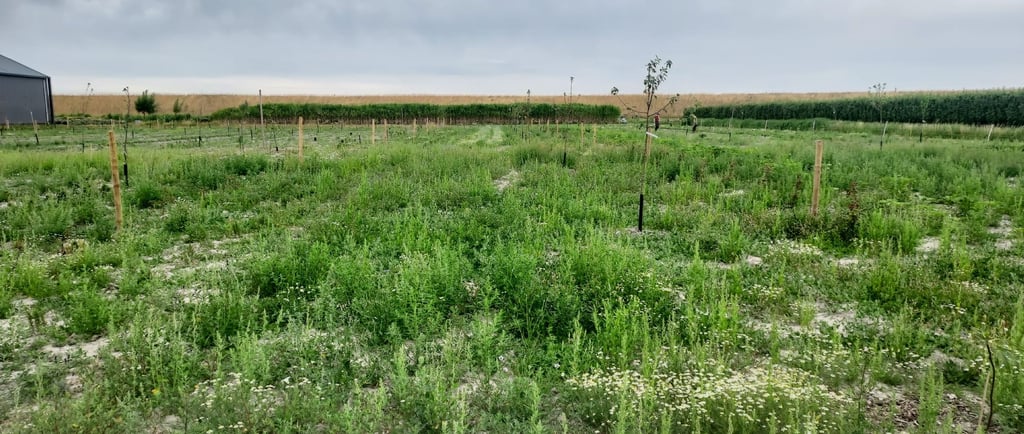
In the heart of Zeeland’s agricultural landscape, a unique and innovative experiment is taking root. Driven by a vision to reduce the ecological footprint of modern agriculture and construction, Wilco and Thea of Dubbeldam Projekt B.V. are transforming their 2.7-hectare location in Stavenisse into an experimental demonstration farm.
Their mission? To explore regenerative practices that combat soil degradation and salinity while building a resilient, diverse agricultural model.
The Challenge: Severely Degraded and Saline Clay Soils
The journey hasn't been without its hurdles. After years of intensive usage (including cultivation under plastic) and dredging out toxic ditches, the heavy clay soil on the property had lost much of its structure. Compounding the problem is the presence of saltwater seepage (zoute kwel) affecting nearly half of the plot alongside the dike.
Instead of seeing this as a dead end, Dubbeldam B.V. saw an opportunity. Working alongside the Agroforestry Netwerk Zeeland, project leader Robin Lock, and enthusiastic students from HAS University of Applied Sciences, they developed a comprehensive trial plan centered around two powerhouse sustainable solutions: Biochar and Agroforestry.
The Strategy: A Twin-Plot Agroforestry Trial
To accurately measure the impact of biochar on plant growth and water retention, the team designed a trial consisting of two identical plots. Both plots integrate an intricate mix of annual (agro) and perennial woody (forestry) crops.
The diverse planting plan features a matrix of rows designed to optimize space and light utilization over a 20-year horizon. The crops include:
Annuals & Vegetables: Barley, potatoes, onions, sweetcorn, and sunflowers.
Berries & Shrubs: Blackberries, raspberries, black and red currants, and sea buckthorn.
Fruit & Nut Trees: Walnuts, hazelnuts, apples, pears, plums, and figs.
Aromatics & Biomass: Lavender, rosemary, wild flowers, and fast-growing Paulownia trees.
To help the heavy clay soil recover, the initial cultivation strategy relies heavily on applying high-quality compost to lower the basic soil pH and build up organic structure.
Why Agroforestry? A Multifunctional "Swiss Army Knife"
As the plan notes, agroforestry acts like a Swiss army knife for farmers, offering a wide array of environmental and financial benefits:
Ecological Intensification: By growing crops across multiple vertical layers, the system captures more total sunlight, yielding a higher Land Equivalent Ratio (LER) than traditional monocultures.
Water Management: Deep tree roots increase the soil’s infiltration capacity, help prevent runoff, and act as a "hydraulic lift," bringing water from deeper layers up to the surface crops. This is critical for creating a freshwater buffer against the surrounding saltwater seepage.
Nutrient Cycling & Nitrogen Efficiency: Trees trap atmospheric nitrogen and capture nutrients that would otherwise leach away, redistributing them to the topsoil through annual leaf fall.
Income Diversification: While perennial fruit and nut trees take a few years to mature, the annual crops provide cash flow right from year one. According to financial projections, a fully matured system can drastically ramp up revenues over a 25-year timeline.
Looking Ahead
By bridging the gap between innovative science and practical farming, Dubbeldam B.V. is showcasing how modern agriculture can evolve. It is a living experiment proving that it is possible to grow food, restore biodiversity, fix carbon, and build a highly resilient farming business all at the same time.-----
Contact
Better Carbon B.V.
Schengestraat 35
4461 EW Goes
Netherlands
KVK / CoC: 98111493
Address
© 2026 Better Carbon BV
Robin: +31 6315 38878
Abhinand: +31 6877 23769
Wouter: +31 6147 59928