Why biochar deserves a place in AD and composting
Read about the many benefits biochar can bring to the table here
7/20/20262 min read
Why Biochar Deserves a Place in Anaerobic Digestion and Composting
Anaerobic digestion (AD) plants already do impressive work, converting organic waste into biogas and nutrient-rich digestate. But there’s a simple addition that can make the entire process meaningfully more effective: biochar.
Whether it’s introduced during digestion itself or blended in during the post-digestion composting phase, biochar brings a set of benefits that touch nearly every part of the process — from microbial performance to the value of the final product.
Reduces Nitrogen Loss
Biochar has a highly porous structure that adsorbs ammonium and ammonia. When it’s added during composting, this translates directly into less nitrogen volatilizing into the air. The practical result is twofold: reduced odor and emissions on-site, and more nitrogen retained in the finished compost — making it a more valuable fertilizer.
Improves Process Stability
Digesters can be sensitive systems. Variable feedstocks, shifting pH, and inconsistent microbial activity can all threaten performance. Biochar can act as a buffer within the digester, helping stabilize pH swings and giving microbial communities a more resilient environment to operate in, even when feedstock composition varies.
Boosts Methane Yield
One of the more interesting findings in recent research is biochar’s role in enhancing biogas production. Its conductive properties appear to support direct interspecies electron transfer (DIET) between microorganisms — essentially giving the microbial community a more efficient pathway for the metabolic exchanges that drive methane production. The result can be a measurable increase in biogas yield.
Enhances the Final Compost or Digestate
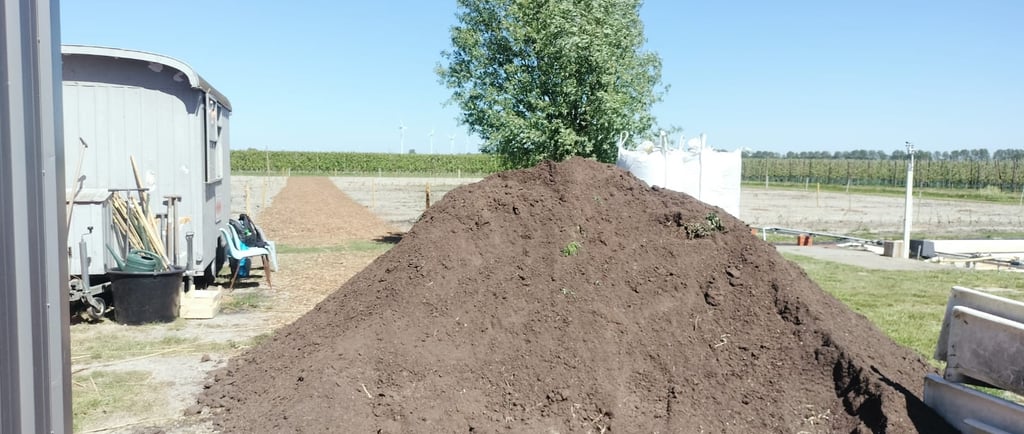
Raw biochar on its own has value, but it’s relatively inert. When it’s blended into compost, it becomes “activated” — charged with nutrients, moisture, and beneficial microbes from the composting process. This activated biochar has better porosity and water retention than raw biochar, and it functions as a significantly more effective soil amendment than either biochar or compost alone.
A Carbon Sequestration Co-Benefit
Biochar is largely composed of stable, recalcitrant carbon that resists rapid breakdown. By blending it into compost or digestate before it’s applied to soil, operators are effectively locking a portion of that carbon away for the long term. This adds a genuine climate benefit on top of the waste management and soil health value already delivered by the process.
Odor and Pathogen Control
Because of its adsorptive surface area, biochar helps bind volatile organic compounds that would otherwise contribute to odor issues during composting. It can also support conditions in the compost pile that discourage pathogen survival, adding another layer of process and product quality control.
The Bigger Picture
For AD and composting operators, integrating biochar isn’t only about environmental performance — though that’s significant. It’s also a business opportunity. A higher-quality end product opens the door to premium soil amendment markets, while improved process efficiency and stability can reduce operational headaches.
As more facilities look for ways to differentiate their end products and improve process resilience, biochar integration is worth serious consideration — not as a fringe additive, but as a core part of a well-designed AD and composting system.
Has your facility experimented with biochar integration? The practical challenges and results at scale are still an area where operator experience is invaluable — feel free to share what you’ve learned.
Contact
Better Carbon B.V.
Schengestraat 35
4461 EW Goes
Netherlands
KVK / CoC: 98111493
Address
© 2026 Better Carbon BV
Robin: +31 6315 38878
Abhinand: +31 6877 23769
Wouter: +31 6147 59928